
Most property management systems are written by software companies that have never run a property. Ours was written by an operator that has run 3,000 of them, hosted more than a million guest stays, and spent eleven years learning, expensively and one building at a time, which parts of this business software can actually absorb.
That system is now a product. OlymOS is live today at olymos.com.
A technology company that happens to own hotels
PIPI's three founders are all computer scientists. Our CEO holds an M.S. in CS from Waseda, our external director a Ph.D. from the same lab, and our CTO was chief engineer before founding two companies.
We started in 2015 managing other people's properties. Within a year the conclusion was unavoidable: the operating leverage in this industry is not in the real estate, it's in the systems. So we built our own, covering pricing, distribution, guest messaging, cleaning dispatch and owner reconciliation, and it has run every property we operate ever since.
We never bought a PMS. Every system we evaluated encoded someone else's operating model, usually a 200-room chain hotel's, and boutique non-standard assets don't fit it. A converted 14-room building in Asakusa and a villa in Karuizawa share almost nothing on paper and almost everything in how they must be underwritten, priced, staffed and sold.
OlymOS is that stack, opened up.
The business is the chain, not the console
Software is the visible part of what we do. It is not the whole of what we sell, and it isn't where the economics live.
PIPI operates the full value chain of a boutique hospitality asset: acquisition, underwriting, development, design and renovation, then operations. OlymOS sits at the center of that chain as the console. What makes it defensible is everything attached to it on either side.

Eris answers the question that decides a property's entire economics before any software matters: what will this lease earn? It's underwriting built on a decade of our own data evaluating and positioning non-standard assets, a category where public comparables essentially don't exist.
Titan Chat are guest messaging as software and as a service. Titan Chat unifies every OTA inbox with instant replies. On Prime, PIPI's own guest-service team answers for you, around the clock, in English, 中文 and 日本語.
Cleaning, the direct booking engine and the Partner API close the loop. The Partner API is deliberately open. Downstream service providers plug in, and new booking and distribution platforms connect through the same interface our own channels use. We'd rather be the layer the industry builds on than a walled garden nobody can extend.
Each of these is a function we already run at scale for our own portfolio. We are not productizing a roadmap. We are productizing a payroll.
We build features for effective operations
The console covers the operating loop from first listing to final payout. A few that only exist because a decade of operations demanded them:
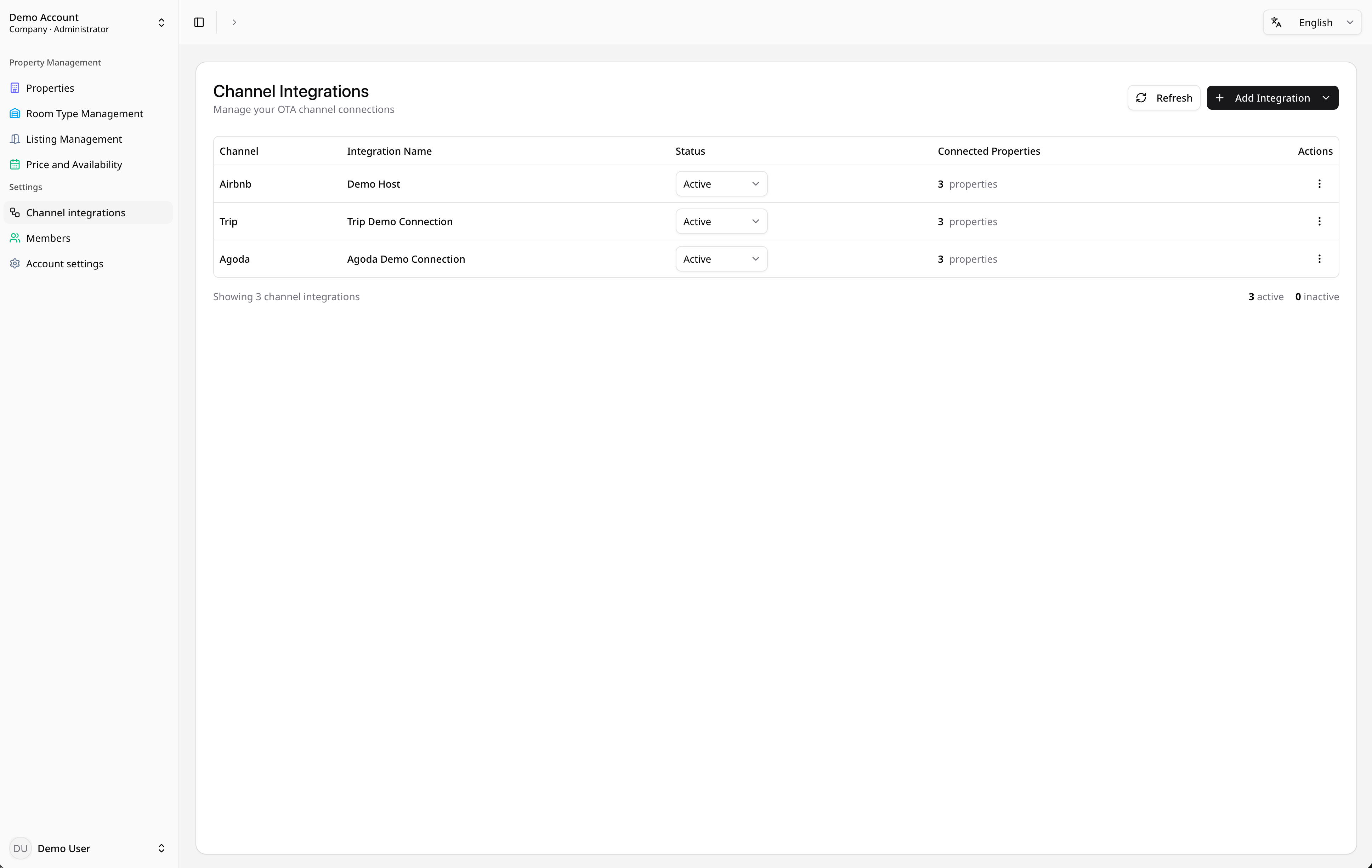
Channel sync runs on native API integrations, not iCal. One rate change fans out to every channel, with a per-channel record of what synced and when.
Pre-check validation is the unglamorous one operators mention first. Every channel rejects listings for its own reasons, usually late and cryptically. OlymOS validates against each channel's rules before you publish and turns every failure into a specific fix rather than an API error code.
Properties and amenities get described once. 100+ amenities across 21 categories map onto each OTA's own taxonomy, so a listing never gets re-typed for a channel.
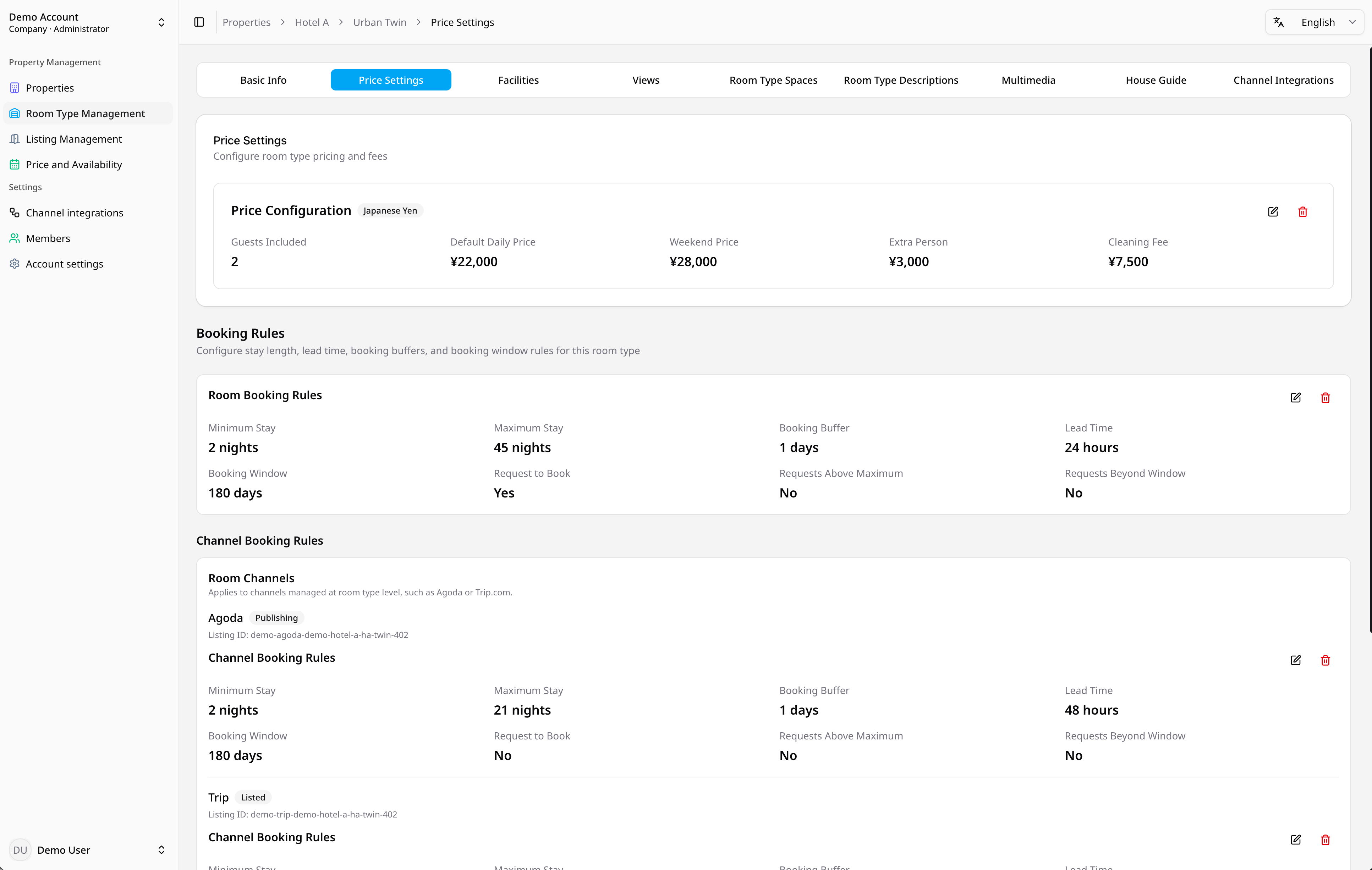
Pricing composes base rate, weekend uplift, extra-guest and cleaning fees into one per-night price, computed once and published everywhere. Booking and cancellation policies are set once and mapped to each platform's own policy system, which matters more than it sounds every time a channel revises its policy model.
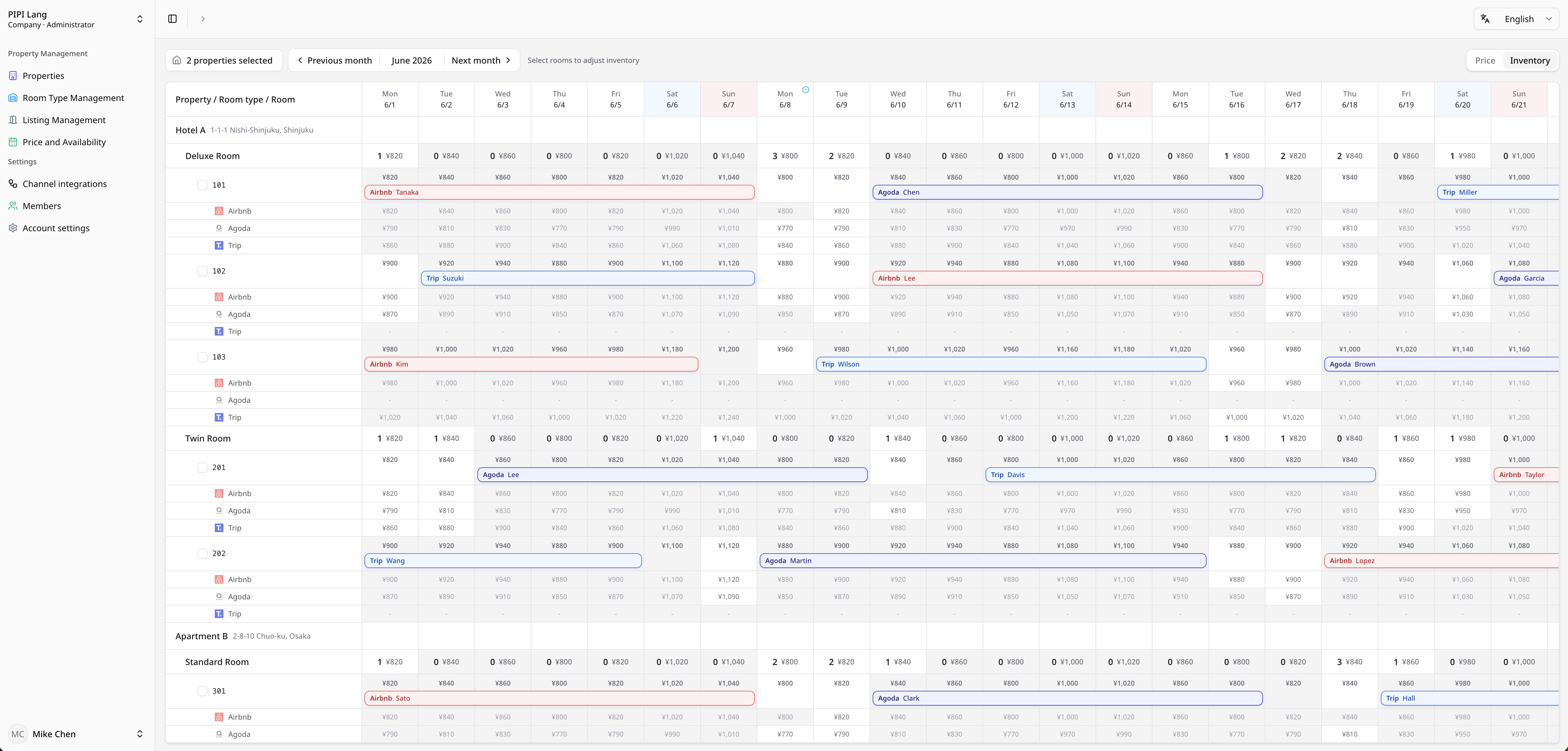
The rest of the loop is reservations, the unified calendar with bulk inventory adjustment, a multimedia manager, house guides, and team roles with granular permissions over calendars, pricing, payouts and billing.
The unit economics
Boutique hospitality has never had a demand problem. It has a fixed-cost-per-room problem. Non-standard assets don't amortize. Every building has its own layout, its own content, its own guest profile, its own local rules. The cost to serve one room doesn't fall as you add rooms unless something structural changes, which is why the segment stays underserved.
Three levers, in our own operation.
Cost side. We run roughly one guest-service staff per 500 rooms, against an industry norm closer to 1:20. That single ratio is the reason a boutique portfolio can be operated profitably at all. It isn't a headcount trick. It's what happens when AI handles the frontline volume and experienced operators handle only the exceptions.
Revenue side. Our properties run roughly +15% RevPAR against local comparables, and about 25% of bookings come direct rather than through an OTA. The first is what a real pricing engine buys you. The second is margin that never touches a commission.
Outcome. Lang Hotel, our urban brand, runs above 90% average occupancy across its operating properties. Lai Villa, our resort brand, runs above 15% average ROI. On whole-building managed properties we're paid on GOP rather than on gross, so we earn on what the asset actually returns. That alignment is deliberate, and it only works if the operating system is good enough to move GOP.
For OlymOS as a product the shape is straightforward. Land with a per-listing subscription across four tiers, then expand into the services layer. The subscription is the wedge. The attach, meaning underwriting, messaging, cleaning and direct booking, is where both the margin and the retention are, and it's the part a pure software vendor can't follow us into, because it requires an operating team rather than a release.
Distribution is a relationship, not a credential
PIPI is an official partner of Airbnb, Agoda and Trip.com (and many more), and OlymOS connects to all three through their native APIs, not a reseller and not an aggregator.
Aggregated connections give you the intersection of what every platform supports: a calendar and a price. Native integration gives you the union, including content, room-type mapping, rate plans, promotions, policy objects, and inbound webhooks for reservations and cancellations. The difference is between pushing availability at a channel and actually operating on it.
That access came from being an operator first. Being ranked the #1 short-term rental agency on my-best.com three years running, holding a Booking.com Traveller Review Award, and being the only STR management company visited by Japan's Minister of Land and Infrastructure is what gets an integration conversation returned. Additional platforms are on the roadmap. We'll announce them when they're live, not when they're planned.
AI at the frontline, veterans on the judgment
Every hospitality product is claiming AI right now. Our position is narrower and, we think, more defensible.
AI belongs where volume lives: guest messages, nightly pricing, content across three languages and three platforms, exception triage. That's where automation compounds, and it's what produces the 1:500 ratio.
But the decisions that determine whether a property makes money, such as which building to sign, how to position it, or when to override a pricing rule for a local event, are made by people who have made those calls a few thousand times. We staff both sides. Most of the market staffs one, and the half they skip is usually the expensive one.
What's live today
Property and room management, pricing and seasonal rules, native channel integration with Airbnb, Agoda and Trip.com, reservation sync, and historical order import are live as of today. Eris, dynamic pricing, the direct booking engine, cleaning dispatch and the Prime messaging tiers are on the roadmap rather than shipped, and we'd rather say so than pad a comparison grid.
It's built for operators running 1 to 100 rooms across multiple OTAs. Large enough to be crushed by channel complexity, too small to buy an enterprise stack, and running exactly the kind of non-standard asset the incumbents were never designed for.
If that's you, the free tier is open at olymos.com. Start with one property and find out in a week what eleven years of paying tuition on this business bought you.